Case study
AI Road Safety System
The Challenge
Road authorities need repeatable, scalable ways to deter dangerous driving—not just more cameras, but interpretations that hold up operationally across sites, lighting, and camera hardware. Our client, a company working directly with a national government, required a confidential program that could detect diverse traffic violations, support review workflows, and produce defensible incident packages.
- Multi-scenario detection (not a single “one model” problem)
- Low-latency processing on live feeds with stable throughput
- Clear operator UX: triage, confirm, and export evidence
- Strict confidentiality: no public references to jurisdictions, deployments, or metrics
Note: This engagement is private and under NDA. We share the problem class and engineering approach—not client identity, deployment maps, or performance numbers.
Our Solution
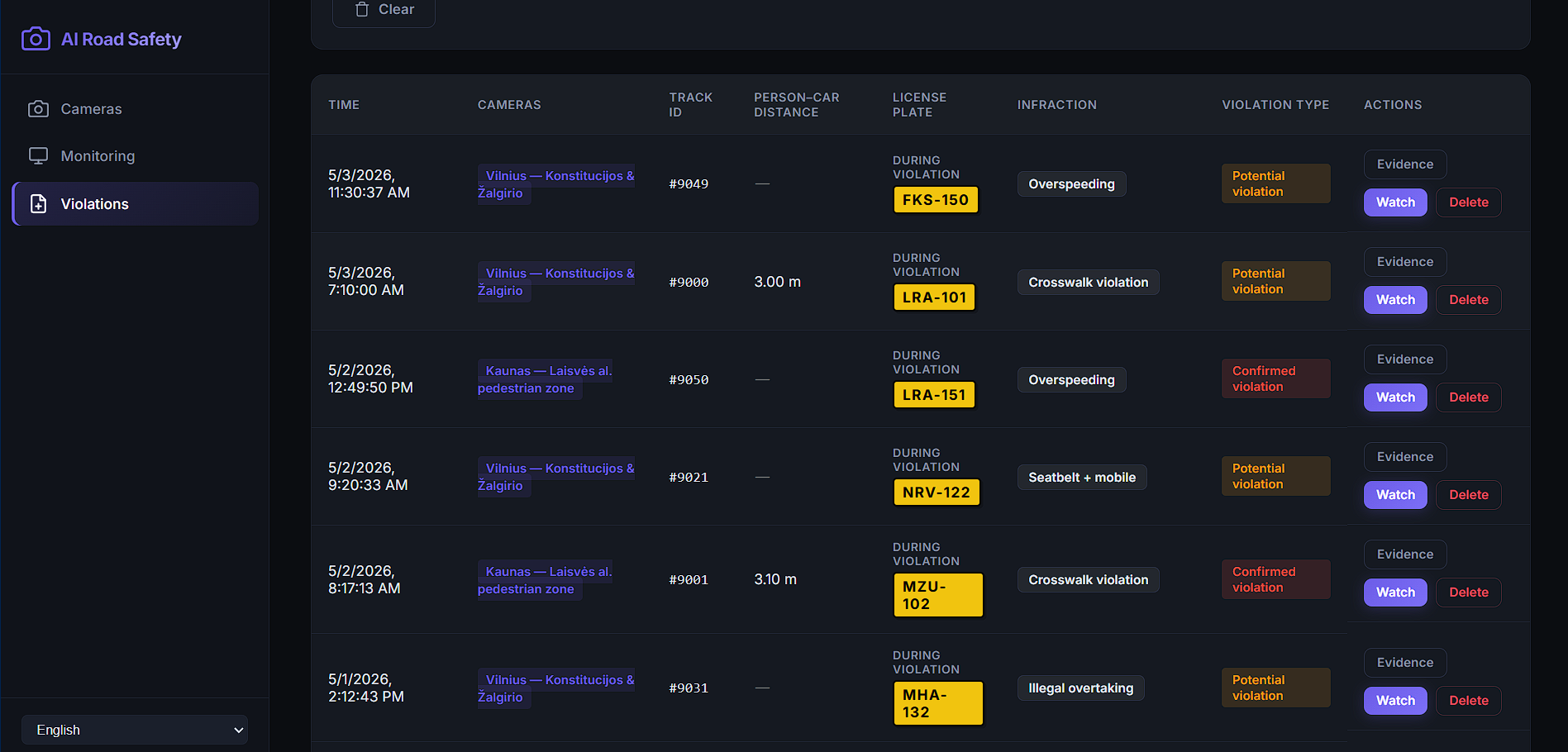
We engineered an AI surveillance stack specialized for intelligent transportation: ingest camera streams, fuse detections with geometry and rules, and surface violations in an operations dashboard with evidence views.
- Violation families including crosswalk conflicts, overspeeding signals, seatbelt and mobile-phone cues, and illegal overtaking—unified under one review surface
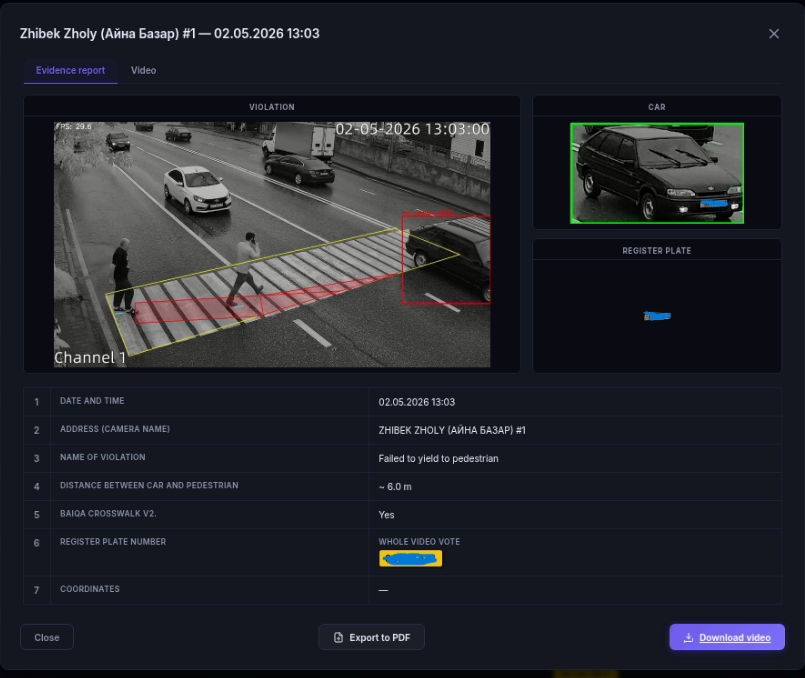
- Spatial reasoning where it matters (for example person–vehicle proximity and zone membership on marked infrastructure)
- License-plate capture paths integrated into the evidence timeline where policy allows
- “Potential” vs “confirmed” states so human operators can adjudicate edge cases responsibly
- Export paths for PDF evidence packs and clipped video—to fit downstream legal and administrative workflows
Challenges We Overcame
- Outdoor variability: Weather, glare, occlusions, and wide-angle distortions across municipal camera estates
- Precision at scale: Reducing nuisance alerts without removing true positives on safety-critical scenarios
- Throughput vs quality: Balancing FPS, model ensembles, and hardware budgets for always-on deployments
- Governance alignment: Designing logs, access patterns, and redaction-ready outputs suitable for regulated use
Technology Stack
Results & Impact
Outcomes remain confidential under client agreement. In general terms, the system gives operators faster review cycles and structured evidence artifacts—while keeping the inference and review pipeline maintainable as new scenarios are added.
- Single cockpit for heterogeneous violation types instead of brittle one-off tooling
- Repeatable packaging of frames, crops, overlays, metadata, and video for adjudication workflows
- Architecture that can evolve with camera rollouts and model refreshes behind the same UX
Project Gallery
Building vision systems for regulated environments?
We can help with traffic AI, surveillance analytics, and operator-grade tooling—scoped to your compliance and deployment reality.
Start a Conversation